
Python! TurboGears!
November 18, 2005 at 12:20 AM | categories: python, cool stuff | View Comments
I have to to tell this story backwards so bear with me.
Yesterday, I watched something that was surprising, amazing, and inspiring all at the same time. It was a video of the making of an entire Wiki, from scratch, in only 20 minutes. Mind you this video was produced by a developer that intimately knows his development environment, but it was nonetheless amazing to just sit and watch the thing evolve in front of me and not get bored in the process of watching it. The video introduces a brand new web application framework called TurboGears.
I guess I'm a bit behind on the times, because I thought plain, vanilla, PHP was pretty cool stuff. It's what I've almost always used for developing web-apps, in both commercial environments and on my own personal time. I had heard of Zope before but until recently had never really considered it much more than an alternative on par with PHP. Enter Ruby on Rails. Until earlier this year, I didn't even know what Ruby was let alone what an MVC was. Ruby on Rails (RoR) is essentially the next big thing, a higher abstraction, in developing web applications. Everyone, everyone but me that is, has been talking about Ruby on Rails... but somehow it completely slipped me by.
Go back a little further in history..
In August, I stumbled on a very unique website called the Python Challenge. It is a site with a series of progressive riddles for (python) programmers. To summarize, it is very addicting. If you haven't tried it, go there right now (warning: if you're at work right now, you might not get back to it today). If you are a programmer (of any skill level) or just happen to like a good puzzle, this web site will challenge you for hours and days and even weeks. I started dreaming of these problems and possible solutions. The Python Challenge litterally tought me how to program Python in about one week. This is in part due to Python being a simplistic (yet oh so powerful), highly abstracted (that means you don't need to know much about computers folks!), well designed language. This is also due to the fact that the Python Challenge seems to cover almost all of the Python Standard Library. Instead of reading through a Python book from front to cover, the Challenge forces you to read certain portions of the documentation in order to solve the puzzle at hand. Then the next puzzle does the same thing for a different part of the documentation. By the time you've gone through ten or so of these puzzles you'll realize that you've read things that you probably never would have read without the motivation, or possibly you just would have skimmed over it without realizing it's significance. But since you were essentially forced into reading it and actually put it to use, you realize it was worthwhile after all and will know to use it again when the opportunity arises. I have since tried to incorporate as much Python into my work and my studies as possible and have found it very rewarding. Suffice it to say, I love Python!
Now, this probably sounds pretty non-coherent by now, if not totally unrelated to the first part of this post, but trust me, I told you all this for a reason. Shortly after reading about Ruby on Rails, and realizing the magnitude of it, while at the same time not relishing the thought of learning Ruby, I googled for "Python on Rails" and came across TurboGears. Now I found something I could really get excited about: a next-generation model for designing and implementing web applications that for all intents and purposes seems just as powerful as Ruby on Rails and just so happens to also be in a language that really excites me. I haven't gotten very far in doing anything with it yet (school and work is a little overwhelming right now) but before seeing these two things together I had almost deemed web development boring.. I never would have thought that it could be this fun again!
Yet another reason why I don't use Microsoft products
November 10, 2005 at 06:22 PM | categories: stupidity | View CommentsI have many reasons why I don't use Microsoft products, let alone non-free software in general, but I just found another.. This is just dumb: Microsoft to incorporate VoIP (Voice over IP) in the next version of Office
Come on... this is an office suite for gods sake... not an entire Operating System. Bloat is one thing, I use Emacs for crying out loud... but not even Emacs has VoIP! The OpenOffice.org people have made a great 2.0 release.. it's funny, sometimes you don't even have to have new development to get better software... you can just wait for Microsoft to do something stupid and the alternatives get better by default!
What Fantasy/Sci-Fi Character are you?
October 20, 2005 at 07:57 AM | categories: enigma curry, cool stuff | View Comments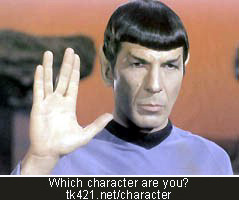
This is a fun little quiz to see what Fantasy or Sci-Fi character you are.
I answered truthfully and I turned out to be Spock... but I was also curious to see what happened if I changed my answers slightly. Did you know what the difference between Spock and Harry Potter is? I'll tell you. Harry Potter would gladly kill his best friend if it were to mean immortality for himself. Thank goodness that isn't something I'm apt to do.. something drastic indeed might have occured had I turned out Harry Potter.
Republic vs Democracy
October 18, 2005 at 03:44 PM | categories: liberty rants | View CommentsMy girlfriend Kellie and I have often brought up, in dialog, the question of what is the difference (if any) between a Republic and a Democracy. For those of you unaware that there was an argument concerning these two things, let's just say that there has been a lot of difference in opinion over the last several hundred years about what these two terms mean.
It is apparent that the founding fathers clearly had a disdain for what they termed "democracy." I could choose from hundreds of statements to exemplify this, but I think that just one coming from Benjamin Franklin very clearly typifies the sentiment:
Democracy is two wolves and a lamb voting on what to have for lunch. Liberty is a well-armed lamb contesting the vote!
But we hear the word "democracy" every day, almost always in a positive light as in sayings such as "we are bringing democracy to the world." The question at hand then is this: Has the meaning of the word somehow changed? Or have the virtues of the founding fathers not been carried down to today's media and politicians? I have a hunch that it's the latter; however, Kellie, being the analytical person that she is, challenges me to consider that the word may have evolved.
Well then, here are my own thoughts on the word "democracy.". . .
When considering the word, with no qualifier of any kind, it is fairly ambiguous. There are a myriad of ways to interpret it, but let's look at two that I feel are the most common:
- In one manner, the singular word (democracy) often alludes to a sense of equality among individuals. This sense is also depicted in the Declaration of Independence when it states that all men are created equal. Let's call this social-democracy.
- In a strictly political sense, democracy vests the power to rule within the realm of the majority. The most common method (and probably the only practical one on a large scale) is by electing representatives. Let's call this political-democracy.
A political-democracy is obviously a true representational form of government. So is a republic. The difference? A republic guarantees that certain things are not and never will be placed up for a vote. The Bill of Rights is one of the most clear examples that there was no intention for this country to form a political-democracy without such guarantees. While semantically I will not dispute the fact that our country is a democracy (although a limited republican form) and should be one, I have to wonder what is going on when the media espouses a very ambiguous word as if it were some utopian, idealistic panacea that everyone should strive for and support. The only conclusion that I can come to, given such an ambiguous term, is that we are being deceived.
After much dialog, I now believe that the word "democracy" HAS changed over the years, not because of cultural reasons or natural language evolution, but because of a series of systematic changes that has occured in our own government. The traditional way for a government to control people is with weapons; however, the populace (at least in the United States) has more weapons than the government itself, so that won't work. The alternative is the much harder task (but still feasable one) of changing our minds by deception.
I just found this document today. It is the Soldier Training Manual (TM 2000-25) published by the War Department in November of 1928 on the topic of Citizenship. Its stated intent is to prepare soldiers that they "may be returned to civilian life better equipped as the defenders of the institutions of our Government in time of peace as well as in time of war." It contains definitions of the two terms we are discussing today. It is prima facie evidence that the US Government had a drastically different take on what democracy is compared with today. Here it is copied directly from the manual itself on pages 91 and 92:
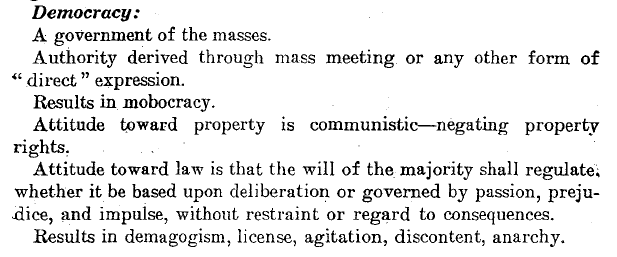
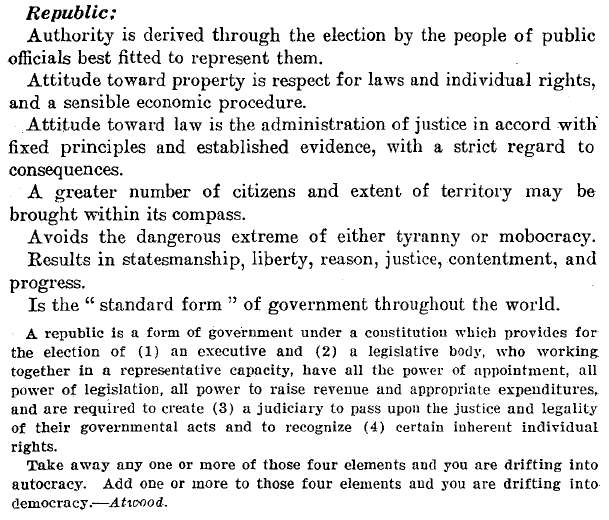
It is rumored that Franklin Roosevelt ordered that this book be destroyed, shortly after his infamous 'banking holiday.' Whether or not this is true, it still shows that there has been a dramatic shift in both the platform of modern politics and also in the meaning of what otherwise appears to be a simple word.
The United States shall guarantee to every State in this Union a Republican Form of Government -- Article 4 Section 4 united States Constitution... what was all the fuss?
This has got to be one of the dumbest products ever
October 11, 2005 at 03:38 PM | categories: stupidity | View CommentsI was just browsing Tiger Direct today and I saw this peice of junk (local copy)
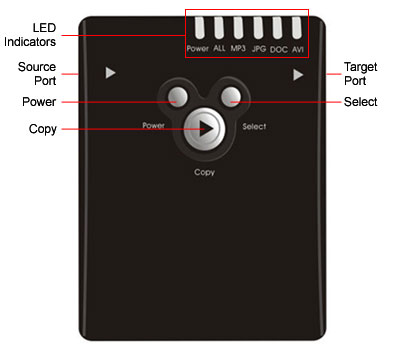
Introducing the Ares Smart X Copy... I wouldn't let this thing near one of my USB devices...
« Previous Page -- Next Page »
Contact me
Friends
- brainjack>>
- Duane McGuire - My Dad
- Erin McGuire - My Sister
- Heavy Noir
- OneWatt
- Six Mile Village

Liberty Links
Categories
- android (rss) (1)
- backups (rss) (1)
- blogofile (rss) (1)
- car computer (rss) (1)
- cats (rss) (1)
- class work (rss) (1)
- cool stuff (rss) (9)
- curlbomb (rss) (1)
- diy (rss) (1)
- economics (rss) (2)
- electronics (rss) (1)
- emacs (rss) (13)
- enigma curry (rss) (8)
- enigmacurry.com (rss) (1)
- free state project (rss) (3)
- games (rss) (1)
- geek humor (rss) (3)
- geeky (rss) (2)
- gmail (rss) (1)
- gnome (rss) (1)
- hd-dvd (rss) (2)
- humor (rss) (2)
- java (rss) (3)
- letters (rss) (2)
- liberty rants (rss) (42)
- linux (rss) (20)
- lisp (rss) (1)
- michael badnarik (rss) (2)
- mitt romney (rss) (3)
- music (rss) (1)
- n800 (rss) (1)
- openoffice.org (rss) (1)
- php (rss) (1)
- pissed off (rss) (3)
- python (rss) (31)
- ron paul (rss) (9)
- security (rss) (5)
- software (rss) (1)
- stupidity (rss) (4)
- uncategorized (rss) (6)
- videos (rss) (9)
Archives
- May 2016 (1)
- July 2011 (1)
- September 2010 (1)
- July 2010 (2)
- April 2010 (1)
- January 2010 (1)
- December 2009 (1)
- July 2009 (1)
- May 2009 (2)
- March 2009 (1)
- January 2009 (4)
- December 2008 (3)
- November 2008 (2)
- October 2008 (1)
- September 2008 (1)
- August 2008 (3)
- July 2008 (1)
- May 2008 (2)
- April 2008 (2)
- March 2008 (1)
- February 2008 (2)
- January 2008 (1)
- December 2007 (1)
- November 2007 (5)
- October 2007 (7)
- September 2007 (3)
- July 2007 (3)
- June 2007 (3)
- May 2007 (3)
- April 2007 (3)
- February 2007 (2)
- November 2006 (1)
- October 2006 (3)
- July 2006 (1)
- June 2006 (1)
- May 2006 (2)
- April 2006 (10)
- February 2006 (2)
- January 2006 (6)
- December 2005 (1)
- November 2005 (5)
- October 2005 (3)
- September 2005 (2)
- August 2005 (5)
- July 2005 (1)
- June 2005 (2)
- May 2005 (7)